Network Effects Game Theory: How To Win When Every Customer You Add Changes The Rules
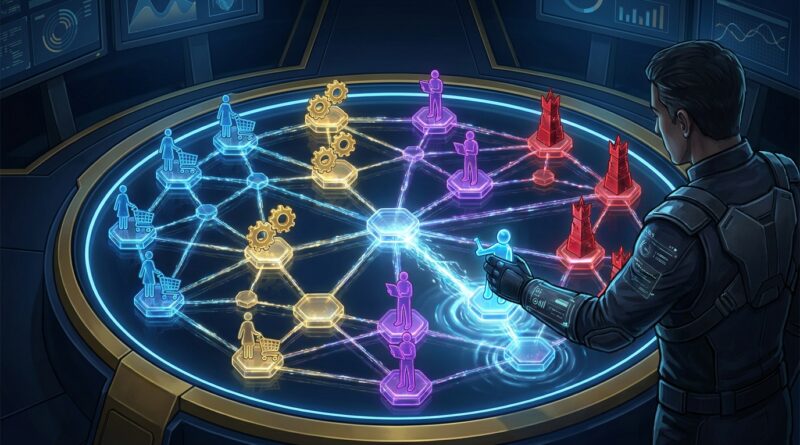
You can feel this problem in almost every growth meeting now. A team adds users, celebrates the chart going up, then wonders why margins shrink, support gets messy, or competitors suddenly get stronger too. That is the frustrating part. More customers do not always mean a stronger business. In markets shaped by network effects, every new user can change the value of the whole system. They can make your product more useful, more expensive to serve, easier to copy, or harder to leave. Founders are not just selling features anymore. They are trying to shape a living network where buyers, sellers, creators, developers, partners, and data all react to each other. If you still think in simple funnels, you miss the real game. The better way to think about it is game theory. Not as an academic exercise, but as a practical way to ask one question. When I add one more customer, what rules of the market change next?
⚡ In a Hurry? Key Takeaways
- In networked markets, you are rarely competing product versus product. You are competing network versus network.
- Start tracking not just customer acquisition cost, but the strategic value each new user adds to retention, referrals, supply, data, and switching costs.
- Growth can hurt you if it adds congestion, fraud, low-quality participants, or dependence on a partner that controls the relationship.
Why normal growth thinking breaks down
Most business plans still assume a straight line. Spend money, get customers, earn revenue, repeat. That works fine for a basic product sale. It breaks when your product gets more valuable because other people are already using it.
Think about a messaging app. The first user gets almost nothing. The hundredth user gets a lot more. The millionth user may get huge value, but only if the network stays healthy. If spam, noise, or poor moderation rise with scale, the same growth that once helped can start doing damage.
That is why the search term matters here: game theory network effects business strategy. It is really about seeing your market as a repeated multiplayer game. Every move changes incentives for users, rivals, partners, and future customers.
What network effects actually mean in plain English
A network effect means one user changes the value for another user. Sometimes that effect is positive. Sometimes negative.
Positive network effects
These happen when more participants make the product better. More sellers on a marketplace can attract more buyers. More users on a collaboration tool can make it more useful inside a company. More developers building add-ons can make a platform harder to replace.
Negative network effects
These show up when growth creates friction. Too many drivers can hurt earnings in a ride-share network. Too many ads can reduce trust. Too many low-quality sellers can scare off good buyers. Congestion is still a network effect. It is just a bad one.
Direct and indirect effects
Direct effects are simple. More friends on the same social app make it better for you. Indirect effects are one step removed. More users attract more developers, which improves the app ecosystem, which then attracts more users.
If you only track signups, you miss the real story. You need to know what kind of value each new participant creates for everyone else.
The game theory lens founders should use
Game theory sounds intimidating, but the core idea is simple. People respond to incentives. In network businesses, they respond not once, but over and over again.
That means your pricing, rules, partner terms, and product design do more than drive one sale. They train the behavior of the network.
Ask these five questions.
1. Who are the players?
Not just customers. Include suppliers, creators, developers, advertisers, channel partners, and even rivals who may share the same users.
2. What does each player want?
Users may want convenience. Sellers may want demand. Developers may want distribution. Partners may want data or control. These goals often overlap, but not always.
3. What moves are available?
You can change prices, open APIs, tighten rules, offer referrals, reward early supply, subsidize one side of the market, or improve portability. Competitors can copy some moves, but not all.
4. What are the payoffs over time?
This is the big one. A customer might be unprofitable in month one but highly valuable if they bring in teammates, create content, improve matching, or increase switching costs. Another customer might look profitable now but weaken the network by adding support burden or attracting the wrong segment.
5. What equilibrium are you creating?
An equilibrium is the stable pattern people settle into. Good network businesses create a stable loop where each group keeps showing up because the others do too. Bad ones create churn loops where one side leaves and the rest follow.
Stop asking “How do we go viral?”
That question sounds exciting, but it is often lazy. Virality is only one small part of network strategy.
A better question is this. What self-reinforcing loop can we build that gets stronger with every good customer we add?
Notice the phrase good customer. Not every customer improves your position. In a network business, quality of participation matters as much as quantity.
How to model the strategic value of a user
Here is a simple framework you can use in a planning meeting.
The 5-part user value score
For each customer segment, score them from low to high on these factors:
- Revenue value. How much do they pay?
- Retention value. Do they make the product stickier for themselves or others?
- Referral value. Do they bring in more users or teammates?
- Ecosystem value. Do they create data, content, supply, integrations, or trust?
- Defensive value. Do they increase switching costs or make your network harder for rivals to copy?
Now add one more score that many teams avoid.
- Network damage risk. Do they create spam, fraud, support load, price pressure, or low-quality inventory?
When you do this, pricing gets smarter fast. You may decide to subsidize users who look cheap on paper but make the whole network stronger. You may raise prices or tighten standards for users who create more harm than value.
Four strategic moves that actually tilt the odds
Subsidize the side that unlocks the loop
Many strong networks do not charge everyone equally. They make one side cheap or free because that side attracts the other. Payment apps may reward consumers first to attract merchants. Marketplaces may court supply before monetizing demand.
The mistake is subsidizing the wrong side for too long. If the subsidized users do not improve matching, trust, or engagement, you are just buying vanity growth.
Design for multi-homing pressure
Multi-homing means users or partners use more than one platform at the same time. Drivers do it. sellers do it. Software users do it too. If customers can easily use you and your rival together, your network may be weaker than you think.
So ask yourself what reduces multi-homing. Better workflows. Unique data. Exclusive tools. Reputation history. Embedded payments. Community. Not lock-in for the sake of it, but real reasons staying is easier than leaving.
Use partnerships like moves on a chessboard
A small integration can be much more valuable than its direct revenue. It can pull your product into a larger ecosystem, lower adoption friction, or increase switching costs. Leaders often underprice this because they only look at short-term sales.
Good partnerships change the game board. Bad partnerships hand control to someone else.
Protect quality before scale hurts you
Every network has a point where scale starts attracting abuse. Fake reviews. Spam creators. Low-quality supply. Slow response times. The earlier you build trust systems, moderation rules, and healthy incentives, the better your odds of keeping positive network effects positive.
Common mistakes smart teams still make
They treat all users as equal
They are not. Some users deepen the moat. Some users dig a hole.
They overfocus on acquisition
If activation, quality, and cross-side liquidity are weak, adding more users can make the experience worse.
They ignore rival reactions
In game theory terms, your move is not finished when you make it. It is finished when you see how the market responds. A referral program, pricing cut, or open API can start a chain of reactions. Model the second and third move, not just the first.
They confuse audience with network
A big audience is useful. A real network has interactions that make participation more valuable over time. Followers alone are not the same as a functioning marketplace, platform, or ecosystem.
A practical workshop you can run this week
If you lead product, growth, or operations, try this with your team.
- List every player in your network.
- Write the value each player gets and gives.
- Identify one positive loop and one negative loop.
- Mark where congestion, poor quality, or dependency can break the loop.
- Choose one move in pricing, referrals, onboarding, or partnerships that strengthens the positive loop.
- Choose one rule that reduces network damage.
This is where strategy gets real. You stop talking about generic growth and start talking about what kind of growth changes the structure of the market in your favor.
How to think about lock-in without becoming user-hostile
Lock-in gets talked about like a dirty word, but not all lock-in is bad. Some of it is simply accumulated value. Shared history, settings, automations, trusted vendors, reputation, and integrations all make a product harder to replace because it is genuinely more useful.
The danger comes when companies confuse friction with value. Trapping users is not the same as earning loyalty. The healthiest network effects come from making the network better, not making the exit worse.
What “winning” usually looks like in 2026
It does not always mean being the biggest. Often it means reaching the point where your network compounds faster than your rival’s.
That can happen because:
- Your best users bring in more best users.
- Your partners deepen distribution at low cost.
- Your data improves matching or personalization.
- Your ecosystem creates tools rivals cannot quickly copy.
- Your quality controls stop the network from poisoning itself at scale.
That is the real shift in business strategy. The smartest operators are no longer asking only, “How do we sell more?” They are asking, “How do we design a system where each new participant makes the next one more valuable?”
At a Glance: Comparison
| Feature/Aspect | Details | Verdict |
|---|---|---|
| Linear funnel thinking | Treats each sale as mostly independent and values users by immediate revenue. | Too limited for platforms, ecosystems, and multi-sided markets. |
| Network effects strategy | Measures how each new user changes retention, referrals, supply, trust, data, and switching costs. | Best for markets where user interactions shape the value of the product. |
| Game theory planning | Models incentives, rival reactions, repeated moves, and stable outcomes over time. | Most useful when pricing, partnerships, and ecosystem plays can change the whole market. |
Conclusion
The big lesson is simple. In many markets now, you are not fighting one product at a time. You are shaping a network, and your competitors are doing the same. That is why leaders who still think in one-off deals and basic funnels keep underpricing the real value of users, partners, and even small integrations. When you treat network effects as a repeated multiplayer game, better decisions start to appear. Pricing gets sharper. Partnerships get more strategic. Referral systems stop being random. Product choices become about strengthening loops, not just adding features. That matters in a winner-takes-most climate where small advantages can compound fast. For the Roll To Win community, this is the practical edge. You do not need to hope for magic viral growth. You need to engineer moves that reinforce themselves, protect quality, and make each good participant improve the system for the next one. That is how you tilt the odds in your favor.